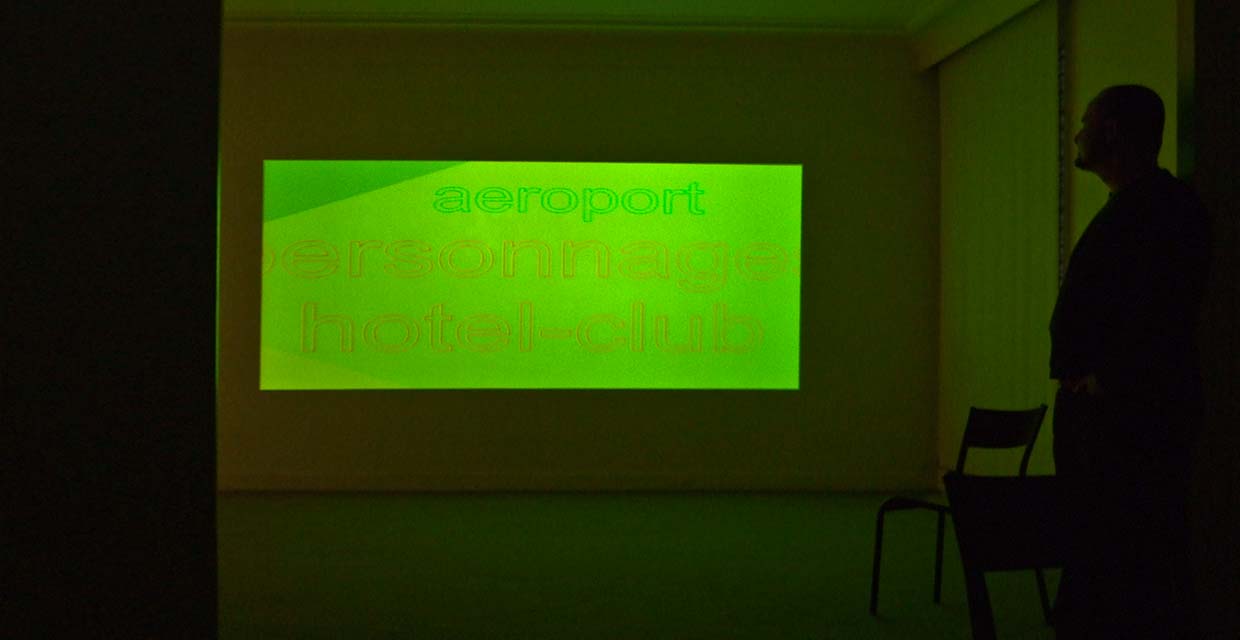
25 to 100 minutes
from 1989 to 2008, and back again
At the start there were those enticements, those micro-worlds on television, in landscapes, on journeys. Everywhere, in fact. I had a feeling some answer was needed, and that it was me who was being addressed: not particularly me, but also me. This was the context. It seemed like a game. But this "something that was being addressed to me" was intra. It perforated discreetly, like modern munitions, acting within to produce a profound blackmail, a shaking of my skeleton, my intimacy. Why are you what you are? Do you manage yourself well? "All right, you?" And it wasn't the world, or in the world, but precisely between the world and me. How to interfere, how to inform. It seemed, finally, more like a war between them; a war between them and me. The insinuation of something was what I regarded as being possible. To intercept, to take up the adversary's arms; to manipulate, to defy, to take hold of language; to modify the context. To force a path into the open air, to inhale… At the start, in fact, I found that quite amusing. Today it's become captivating – starting with the very ambiguity of the term.
Might the Object be a player?
What Vermeer's lace maker conceals, and what Hitchcock's McGuffin reveals
The Subject qualifies the world, and this places it at the centre: it's taken the lead… Let's imagine the contrary hypothesis, according to which, in the great modernist trick of desire, the Object has also been liberated. No longer exploited, it determines. A role reversal produced by all the various forms of liberation: that of the Subject, which would mask that of the Object, now notionally at the centre. Taking advantage of the general mobility, it shirks every onus the Subject would place on it, leaving the latter cut off from the world, submerged in data it can no longer project. Its determination by the Object is no longer dialectical, but of the order of defiance and metamorphosis. The hypothesis is thus that of a reversion. Transcendental blackmail and alienation are replaced by an edgy immanence, labyrinthine and mobile – that of double lives – and it's hard to know what to do with the data.
Enter your PIN
More generally, the hypothesis of complete liberation (apparently
optimistic: no more masters or slaves; everyone decides; but the Other
has disappeared!) casts light on a space of continuity and circulation –
a network in which we encounter only our alter egos. It also identifies
an entity: the communication terminal as receptacle and vector, portal
of all solitudes, likely to actualise the very question of
continuity, with its rites, its violence, and what binds us to others;
to the world. In other words, does eroticism in an age of individuals
not enshrine the mobile phone as a sexual organ? Always online with the
tribe, and every night a new Kama Sutra position by voice mail…
More precisely
The Subject being what modernity has attempted to produce, in the mode
of sovereignty (though without success – it produced merchandise), the
Object constitutes a disjunction in this game, the trigger of a
reversion that will get play going again – but the Subject has lost the
lead! So it's beyond obscenity (that of production, networks and sex)
that we now have to seduce, in return: a rediscovery of secret pacts,
provisional and changing, with the world and with things.
In the realms of art, nowadays, the Object exists only with respect to
its creator, and only to the extent that this creator (or his
promotional entourage) demonstrates the charge (useful or useless,
according to taste) with which he is invested. Whereby the ready-made
would have brought modernity to a premature conclusion. It was by
radicalising its own autonomisation that the avant-garde, like Oedipus,
finally precipitated art into the culture industry and merchandise. Can
the business of art be confined to the short circuit that goes straight
from cooptation to celebration, and back again – or the even shorter one
that goes from a promotional argument to its formal manifestations, but
this time with no return? Certainly not! That would be of the order of
an advent, or of the productive management of what remains of the event
when it is no more. But the event itself, the accident (grain of sand or
tsunami) as a fleeting opening onto the improbable is what instantiates
the world, while also connecting us to it. The event is what must be
seduced (not produced) in order to belong to the world.